Glucosamine Sulfate in MotionPrimeX: The Dose, the Evidence and Who Should Skip It
Quick answer
MotionPrimeX gives 1,000 mg of glucosamine sulfate a day, made from crayfish. Studies mostly used 1,500 mg. The large GAIT trial found no overall benefit over placebo, Cochrane found benefit mainly with one prescription brand, and the 2019 ACR/AF guideline advises against it. Skip it with a shellfish allergy and ask a doctor first if you take blood thinners.
What is glucosamine sulfate?
Glucosamine is an amino sugar sold as a joint supplement. It comes in two common forms, glucosamine sulfate and glucosamine hydrochloride, and it is usually made from shellfish shells or by fermenting grain (LiverTox (NIDDK), Glucosamine).
MotionPrimeX uses the sulfate form. The brand says its glucosamine comes from crustacean shellfish, namely crayfish. That one fact matters more for safety than anything else on this page.
- Label name
- Glucosamine Sulfate
- Amount in MotionPrimeX
- 1,000 mg per 2-capsule serving
- Source
- Crustacean shellfish (crayfish), per the sales page FAQ
- Share of the formula
- About 71% of the 1,400.1 mg the label lists (our arithmetic)
- Usual studied dose
- 1,500 mg a day
What does the MotionPrimeX sales page say about glucosamine?
The sales page prints the 1,000 mg amount and the crayfish source, which is honest and useful. Its research claims go further than the studies do, so we sorted each line below.
- On the label
Glucosamine Sulfate 1,000 mg
Sales page and seller packThe amount is printed. No Supplement Facts panel image exists, so this is the sales page figure.
- On the label
Derived from crustacean shellfish (crayfish)
Sales page FAQA clear allergen statement. It also means the formula is not shellfish free.
- Marketing only
Clinical trials consistently show it supports joint comfort, reduces stiffness, and slows cartilage breakdown
Sales page, glucosamine sectionTrial results are mixed, not consistent. The largest US trial found no overall benefit over placebo.
- Marketing only
Supports joint cushioning & cartilage rebuilding
Sales page headlineNCCIH calls the effect on joint structure uncertain. No study of this formula exists.
Where glucosamine sits on the brand graphic
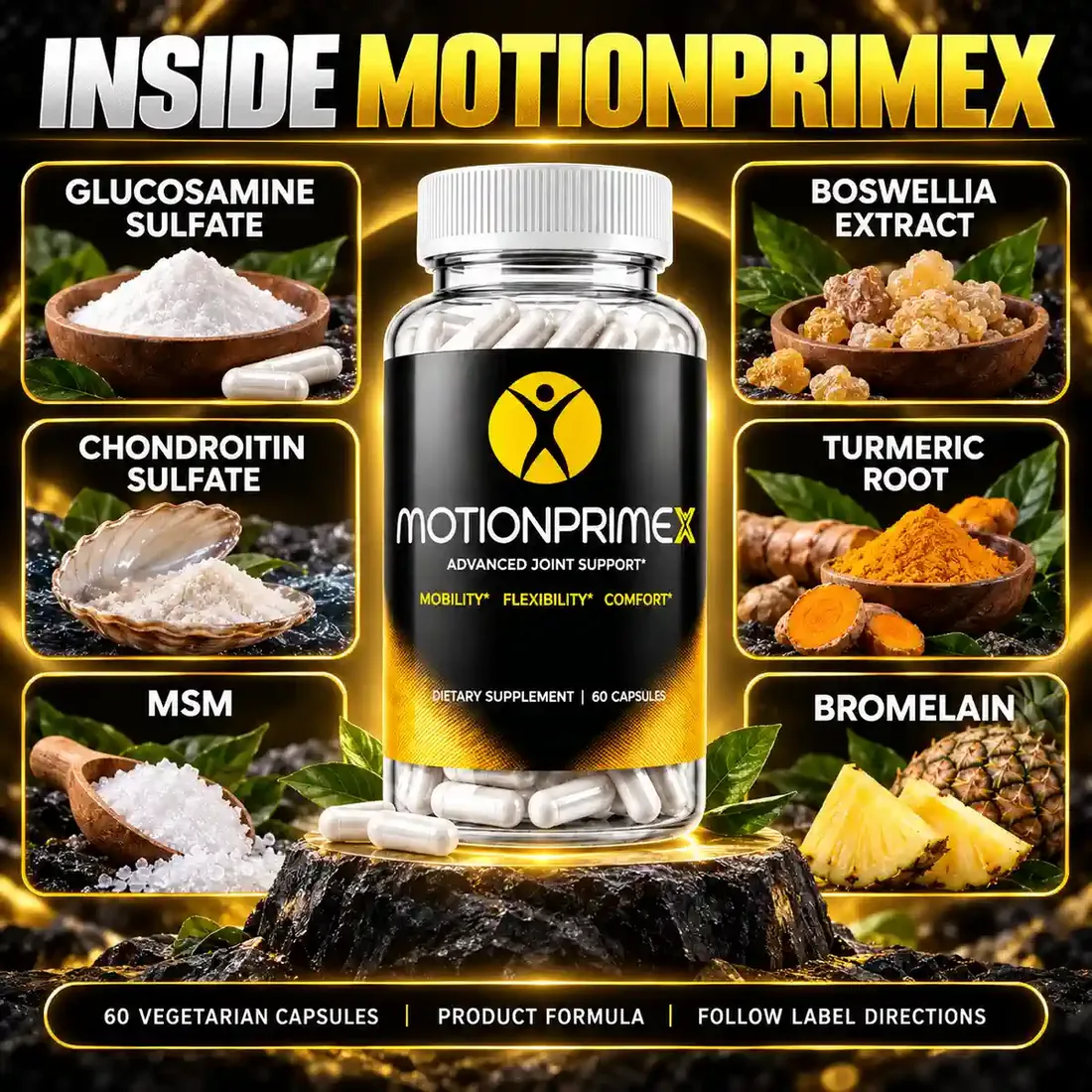
- Glucosamine sulfate panel. A bowl of white powder. The graphic gives no amount; the sales page says 1,000 mg.
- The bottle. 60 capsules; at 2 a day, one bottle lasts 30 days.
- "60 vegetarian capsules". The capsule shell may be vegetable, but the glucosamine inside comes from crayfish.
- Only 6 of 8 ingredients. Quercetin and methionine are on the label but not in this picture.
Tap a number to read each note. The picture is the brand's own artwork, not a lab photo of the powder.
Thinking about MotionPrimeX? The best price is on the 6-bottle pack.
6 bottles for $294, $49 a bottle. 60-day money-back guarantee · Free US shipping on 3+ bottles · Secure checkout.
Is 1,000 mg of glucosamine the dose used in studies?
No. Most research used 1,500 mg a day, so the label gives two-thirds of the usual studied amount. The bar below draws that gap to scale.
Per 2-capsule serving, taken once a day before a meal.
The dose given daily for 24 weeks (NEJM 2006, Clegg et al., GAIT trial).
500 mg three times a day, as package labels and LiverTox describe (Cochrane 2005, Towheed et al., Glucosamine for osteoarthritis).
Form matters too. GAIT used glucosamine hydrochloride, and Cochrane found the positive results came mainly from trials of one prescription glucosamine sulfate brand made by Rotta. A label that says "glucosamine sulfate" is not that product. We do not suggest taking extra capsules to reach 1,500 mg.
Does glucosamine work for knee pain? What the studies found
Not clearly. The best US trial found no overall benefit over placebo, reviews disagree, and the 2019 arthritis guideline advises against it.
The GAIT trial, arm by arm
| Group (daily, 24 weeks) | Extra share with 20% less knee pain, vs placebo | Better than placebo? |
|---|---|---|
| Placebo | 60.1% responded (the baseline) | Baseline |
| Glucosamine 1,500 mg | +3.9 points | No |
| Chondroitin 1,200 mg | +5.3 points | No |
| Both together | +6.5 points | No |
| Celecoxib 200 mg (the drug comparison) | +10.0 points | Yes |
Only the drug beat placebo (NEJM 2006, Clegg et al., GAIT trial). A small group with moderate to severe pain did better on the combination, but the lead investigator called that finding preliminary (NIH news release, GAIT results (2006)). The Arthritis Foundation adds that a 2010 follow-up found no advantage over placebo (Arthritis Foundation, Glucosamine and Chondroitin for OA Pain).
How the evidence built up, 2005 to 2019
- 2005
Cochrane review
25 trials, 4,963 patients. Benefit showed up mainly in trials of the Rotta brand; better-run and non-Rotta trials showed none.
- 2006
GAIT
No overall benefit for glucosamine, chondroitin or both at 24 weeks.
- 2008
Hip study
Glucosamine sulfate was no better than placebo for hip osteoarthritis.
- 2018
Pooled analysis
29 studies, 6,120 people: glucosamine alone eased knee pain, but results were inconsistent.
- 2019
ACR/AF guideline
Strongly recommends against glucosamine for knee, hip and hand osteoarthritis.
The 2008 and 2018 results are as NCCIH reports them (NCCIH, Glucosamine and Chondroitin for Osteoarthritis). The guideline wording comes from NCCIH and a family medicine summary (Am Fam Physician 2020, Barry, summary of the ACR OA guideline), which notes that a negative call can mean weak evidence of benefit rather than proof of no benefit. Memorial Sloan Kettering describes the same advice as a conditional one.
Is glucosamine safe? Shellfish, blood thinners, blood sugar and liver
For most adults in trials, side effects were mild and about as common as on placebo, mainly stomach upset. Four groups need more care, and each one applies to this formula.
Shellfish allergy
The glucosamine in MotionPrimeX comes from crayfish. The Arthritis Foundation says to avoid glucosamine with a shellfish allergy, and Memorial Sloan Kettering warns of possible allergic reactions (Memorial Sloan Kettering, Glucosamine (About Herbs)). If you have this allergy, skip the product.
Blood thinners and INR
Regulators have collected reports of glucosamine raising INR, the blood test for warfarin. Singapore's Health Sciences Authority summed up 12 Australian reports, with INR rising in 10, and 22 WHO cases; in 17 of them the effect settled after glucosamine was stopped (Health Sciences Authority, Warfarin-glucosamine interaction reports). Some people bled and needed hospital care. The sales page itself tells buyers on blood thinners to ask a physician first.
Blood sugar and diabetes
Glucosamine may raise blood glucose, and Memorial Sloan Kettering says it could worsen insulin resistance. If you have diabetes, talk to your doctor and check your readings more often if you start it.
Liver
LiverTox rates glucosamine a possible but rare cause of liver injury (likelihood score D) (LiverTox (NIDDK), Glucosamine). Controlled trials have not linked it to liver enzyme rises. Memorial Sloan Kettering still advises people with liver disease to avoid it.
Every ingredient side effect is gathered on the MotionPrimeX side effects page, and the shellfish and blood thinners post goes deeper.
Who should skip glucosamine or ask a doctor first?
People with a shellfish allergy should skip it. People on blood thinners, with diabetes or with liver disease should ask first. This check runs on your screen; nothing is saved or sent.
Glucosamine fit check
Are you allergic to shellfish, such as shrimp, crab or crayfish?
Do you take warfarin or another blood thinner?
Do you have diabetes or high blood sugar?
Do you have liver disease?
Answer every question to see your result. Nothing is saved or sent.
No flags from these four questions. Read the full label and keep to 2 capsules a day.
Talk to your doctor or pharmacist first and bring the ingredient list. These are the groups the sources single out.
Skip MotionPrimeX. Its glucosamine comes from crayfish, a shellfish.
How does glucosamine fit into MotionPrimeX?
It is the main ingredient by weight, about 71% of the formula. The next largest are boswellia at 133.3 mg and chondroitin and turmeric at 100 mg each.
Its partner in the GAIT trial was 1,200 mg of chondroitin; MotionPrimeX pairs it with 100 mg, as the chondroitin page explains. You can see all eight amounts on the MotionPrimeX ingredients page.
The steps the 2019 guideline strongly backs are not pills: exercise, weight loss if you are overweight, tai chi, self-management programs, and canes or braces. A supplement fits alongside those, not in place of them or of your doctor's care.
Glucosamine: questions people search
Does glucosamine work for knee pain?
Not clearly. In the GAIT trial of 1,583 people, 1,500 mg a day was no better than placebo at 24 weeks, and the 2019 ACR/AF guideline recommends against it.
Is glucosamine safe with a shellfish allergy?
Not in MotionPrimeX. Its glucosamine is made from crayfish, and the Arthritis Foundation advises avoiding glucosamine if you have a shellfish allergy.
Can you take glucosamine with blood thinners?
Only with your doctor's approval. Regulators have reports of glucosamine raising INR in people on warfarin, sometimes with bleeding, so INR needs close checks.
Does glucosamine affect blood sugar?
It may. NCCIH says glucosamine may raise blood glucose, so people with diabetes should check with their doctor and watch their readings.
Can glucosamine hurt your liver?
Rarely, if at all. LiverTox gives it a D score, a possible rare cause, but people with liver disease are told to avoid it.
What is the glucosamine dose used in studies?
1,500 mg a day, often as 500 mg three times a day. MotionPrimeX gives 1,000 mg, two-thirds of that.
Is glucosamine sulfate better than glucosamine hydrochloride?
Not proven. Some researchers favor the sulfate form, but one head-to-head study found no real difference, and GAIT used hydrochloride.
What are the common side effects of glucosamine?
Mostly mild stomach upset. In the Cochrane review, side effects were about as common as on placebo.
How long does glucosamine take to work?
No source we used gives a start time. GAIT checked results at 24 weeks; the sales page's 3 to 4 weeks is not backed by a study of this product.
Page check
Written by
Checks every amount against the sales page and the pack, and every health line against NIH, CDC, NCCIH and Cochrane sources.
Medically reviewed by
Dr. Kevin D. Plancher, MD, Physician
Medical reviewer. Review date: October 12, 2026.
- Last checked October 12, 2026
- Facts from the bottle, the sales page and the sources cited above
- Found an error? Write to [email protected] or read how we check facts